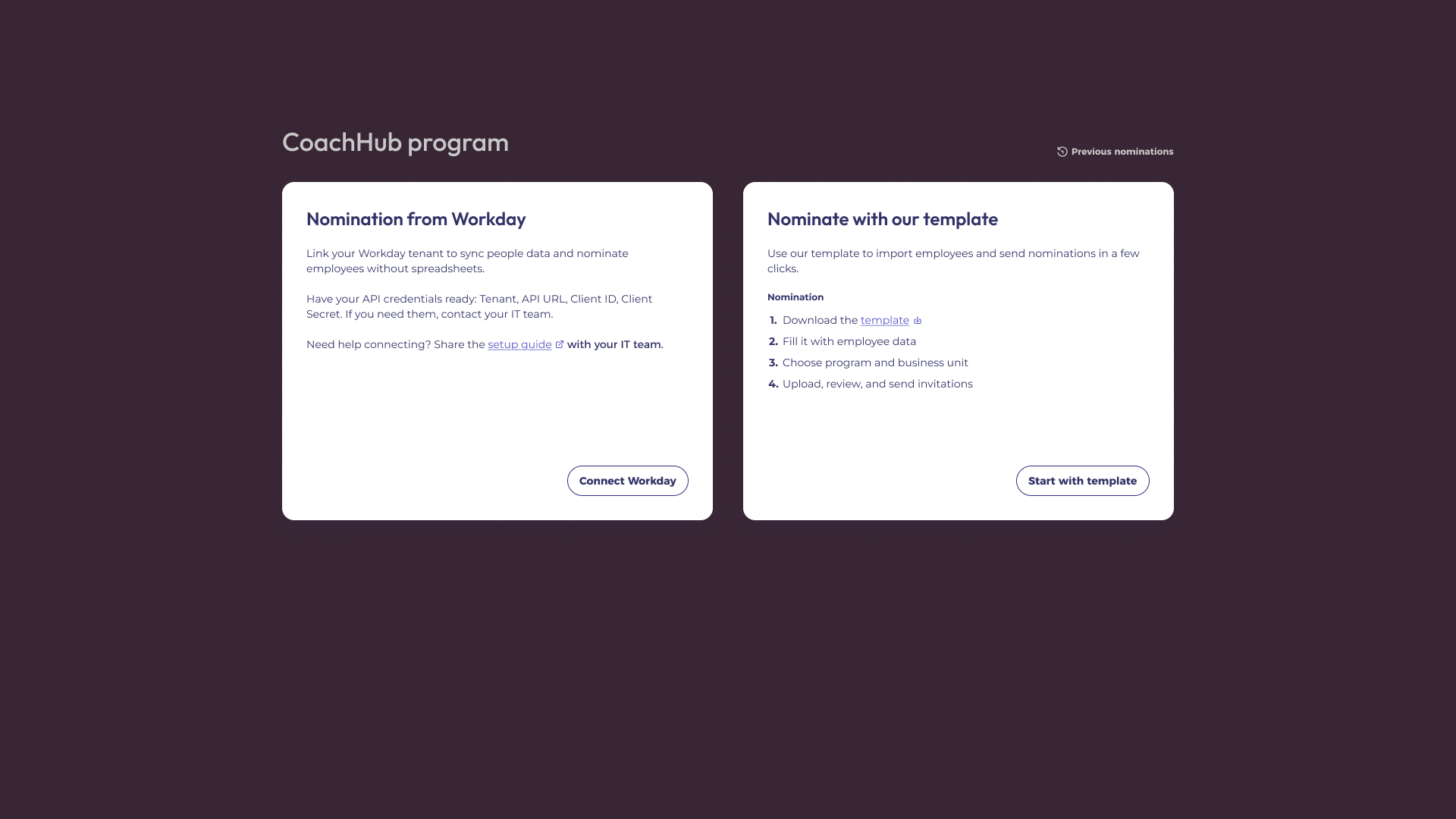
Program Nomination Integration
Connecting CoachHub to Workday so admins can nominate employees into coaching programs without leaving the platform
The Problem with Spreadsheets
Program managers at CoachHub are responsible for enrolling employees into specialised coaching programs. Before this project, that process required exporting employee data from their HR system, formatting it into a spreadsheet, and uploading it manually to CoachHub. Each nomination cycle introduced opportunities for outdated records, formatting mismatches, and synchronisation delays between what lived in the HR system and what CoachHub actually knew about a person.
The immediate goal was concrete: allow program managers to nominate coachees directly via a Workday integration, eliminating the spreadsheet step entirely. The broader ambition was architectural. This was the first instance of a platform connectivity layer that CoachHub would eventually extend to other HR systems and use cases. The design decisions made here would set a precedent for how integrations feel and behave across the product.
That dual scope shaped the design challenge significantly. The solution needed to be specific enough to work for Workday today, and considered enough to establish patterns that would hold as the integration surface expanded.
Designing for Admin Confidence
Program managers are not technical users. Connecting an enterprise HR system via API credentials requires information like tenant ID, client ID, and client secret, terms that are routine for an IT team but opaque for an HR manager running a coaching program. The setup flow had to bridge that gap without placing the cognitive burden on the wrong person.
The approach was to treat the integration setup as a guided handoff rather than a configuration form. Each step surfaces exactly the information the program manager needs at that moment, with clear guidance on where to obtain credentials they do not have, and explicit instructions to involve IT when required. The flow does not assume knowledge it cannot guarantee. It anticipates the moment a program manager encounters an unfamiliar field and provides the path forward rather than leaving them to figure it out.
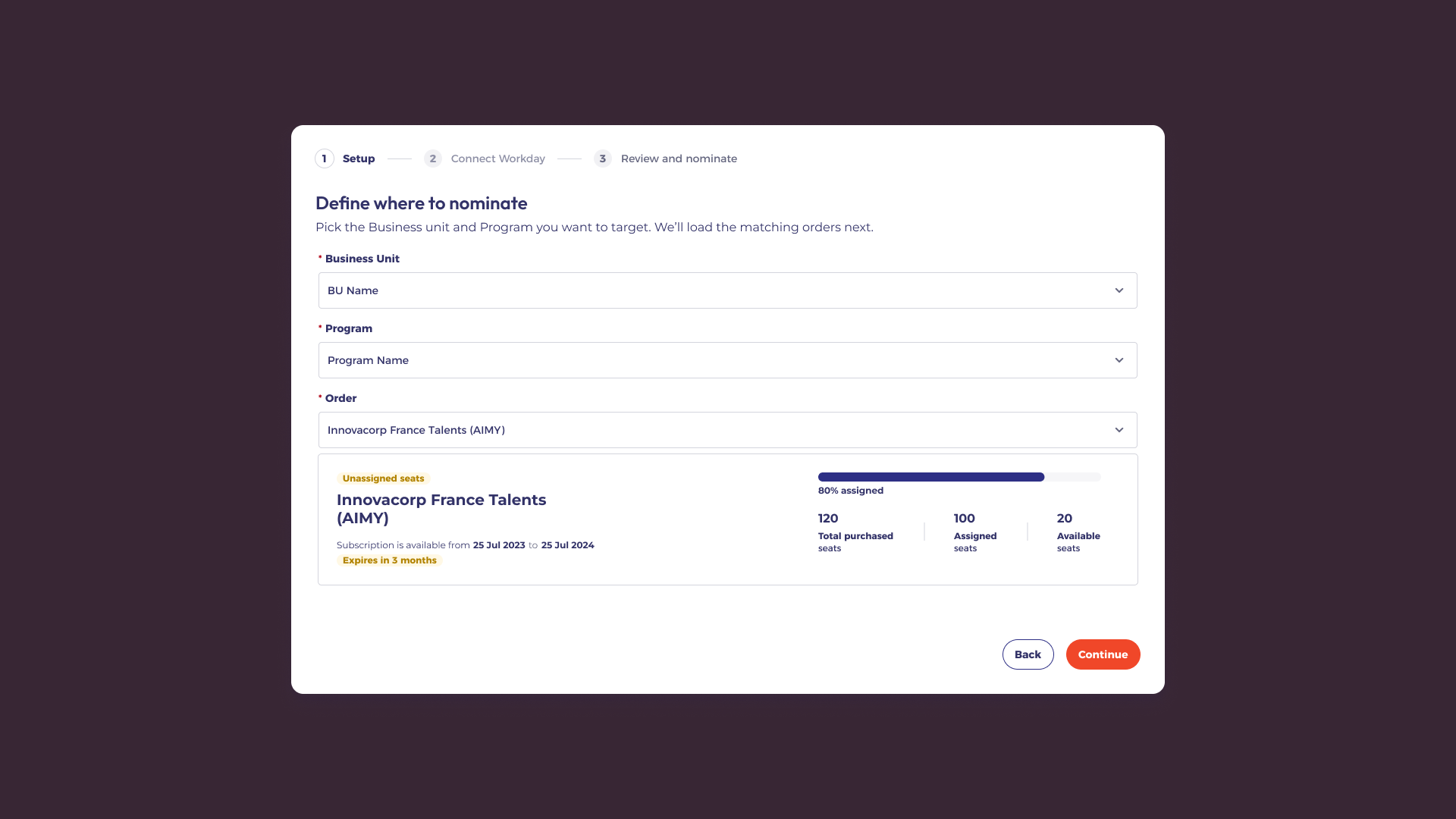
Once credentials are entered and validated, the program manager selects the target business unit and coaching program. From there, CoachHub pulls the relevant employee data from Workday and loads it for review. The entire setup sequence is broken into discrete, recoverable steps: each stage confirms what was just completed before asking for the next input, reducing the risk of error and building confidence as the connection is established.
Review, Search, Nominate
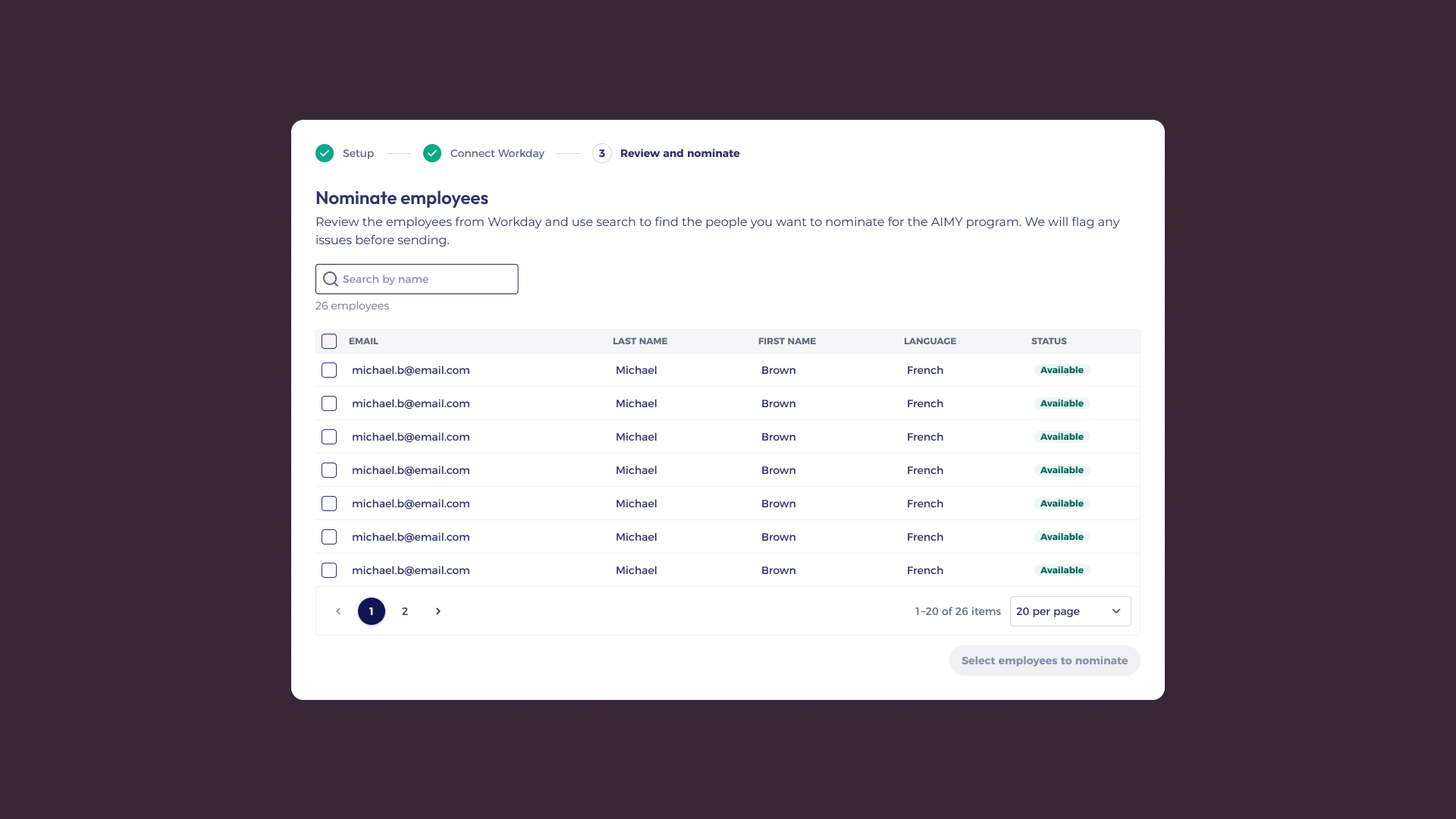
Once the Workday connection is live, the nomination step becomes a data review task rather than a data entry task. CoachHub surfaces the employee list synced from Workday and puts search and filtering at the centre of the interaction, because program managers are typically nominating a specific subset of employees, not the entire roster.
Validation runs before submission, not after. Any employee record that would cause a downstream issue, a duplicate enrollment, a missing required field, or a data conflict between Workday and CoachHub, is flagged inline with enough context for the program manager to understand the problem and decide how to proceed. This shifts error handling from a post-submission failure state into an active review step, preserving the program manager's agency and preventing silent failures that would have been invisible in the spreadsheet workflow.
The nomination confirmation is explicit and auditable. Program managers see exactly who they are nominating, into which program, before anything is submitted. The review screen doubles as a record of intent, giving both the program manager and the organisation a clear reference point if questions arise later.
Impact and Foundations
The integration removed the spreadsheet entirely from the nomination workflow. Program managers can now move from a connected Workday tenant to a confirmed set of nominations inside CoachHub without touching an external file or re-entering data that already exists in their HR system. The reduction in manual steps directly reduces the risk of stale or incorrect employee records reaching the coaching platform.
The inline validation model proved particularly valuable. By surfacing data conflicts before submission rather than surfacing errors after, the flow gives program managers control over data quality at the point where they can still act on it. This was a deliberate departure from the pattern of submit-and-fix, which had been a source of friction in earlier manual workflows.
Beyond the immediate Workday use case, the project established a reusable design language for how integrations are set up, how external data is previewed, and how errors are communicated across the CoachHub platform. Future integration work, whether with additional HR systems or entirely different data sources, inherits a tested interaction model rather than starting from scratch.